

April Market Rate Update

Each month the IAACU Small Business Team aims to provide you with insights into current trends in commercial real estate market rates, which are influenced by movements in the U.S. Treasury yield.
Gradually Rising - Treasury Yields Continue to Support Attractive Commercial Real Estate Financing Conditions
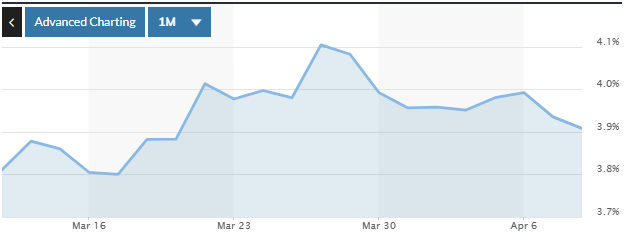
U.S. Treasury yields moved higher in March 2026, reflecting renewed inflation persistence and a Federal Reserve that remains cautious about easing policy.
The 5‑year U.S. Treasury yield averaged approximately 3.92% in March, up meaningfully from the 3.50%–3.65% range seen in February. Yields began the month near 3.62% and climbed above 4.00% briefly in the latter half of March, with an intra‑month high near 4.10%, before ending the month just under 4.00%.
This upward move came alongside increased supply pressures in the Treasury market, firm economic data, and lingering concerns about sticky inflation, particularly energy‑driven components. While volatility remains contained by historical standards, March marked a clear variation from the benign, sideways rate environment observed earlier in Q1.
Updated Fed projections now imply fewer near‑term cuts than investors expected late in 2025, reinforcing a “higher‑for‑longer” narrative. As a result, intermediate and long‑duration Treasury yields (particularly the 5‑year and 10‑year) have repriced upward, even as short‑term rates remain contained by Fed policy.
Implications for Commercial Real Estate (CRE) Financing
1. Treasury Stability Has Given Way to Measured Upward Pressure
Despite recent increases, Treasury yields remain below their cycle highs from 2025. However, March clearly signaled that the rate floor is behind us. Borrowers who delayed fixing in hopes of materially lower benchmarks are now facing higher coupons, reinforcing the importance of proactively securing rates during periods of relative calm.
2. Commercial Real Estate Loan Pricing Is Still Competitive—But Sensitive to Timing
Commercial mortgage rates remain attractive in historical context, but absolute pricing has moved higher alongside Treasuries. Because CRE loans are priced as a spread over benchmarks, incremental Treasury increases feed directly into all‑in coupons.
Execution speed and rate‑lock strategy now meaningfully impact company finances. Borrowers who fix during rate pullbacks (or are able to lock early in the process) are generally achieving better outcomes than those staying floating while awaiting clarity.
3. Fixing Rates Has Gained Strategic Value
In a rising‑rate environment, rate certainty has become a form of risk management. Many borrowers are shifting away from short‑term floating exposure toward:
- Longer initial fixed‑rate periods
- Early rate locks during due diligence
- Hybrid structures with defined conversion mechanics
Rather than chasing lower rates, sponsors are prioritizing budget stability, exit flexibility, and protection against continued upward drift.
4. Current Loan Rate Landscape (Late Q1 / Early Q2 2026)
Lenders remain active and competitive, particularly on well‑capitalized deals. Credit discipline has tightened modestly, but spreads remain reasonable relative to benchmarks.
| Asset Class | Typical Fixed‑Rate Pricing | Commentary |
| Multifamily | 6.00% – 6.60% | Still benefits from deep lender liquidity and agency support |
| Industrial / Office | 5.90% – 6.50% | Strong assets and sponsorship drive best outcomes |
What This Means For You
While financing conditions remain beneficial, March 2026 underscored the importance of timing and rate discipline. The window for ultra‑low benchmarks has more than likely closed, and future volatility is more likely to push rates higher than meaningfully lower in the near term. If you are evaluating acquisition financing, refinancing, or balance‑sheet restructuring, fixing rates during periods of Treasury stability can reduce long‑term risk. A thoughtful rate‑lock strategy, aligned with asset cash flow and investment horizon, may now be just as important as headline pricing.
Contact our Small Business Team to see what we can do for you.
Read our March Market Rate Update.
Rates from Resource Center | U.S. Department of the Treasury as of April 8, 2026.
Graph from MarketWatch.
